✦ Liuzhou, in China’s Guangxi region, has been famous for handcrafting high-quality coffins since the Tang Dynasty ✦ Since 1979, its mini coffin souvenirs have been sold across China and become popular souvenirs in Hong Kong, Macau and beyond ✦ In villages like Liudao outside Liuzhou, families still carve full-size coffins, even as decades of cremation policy and a slowing real-estate sector reshape the trade’s future
✦
LESS THAN AN hour’s drive out of Liuzhou, the ubiquitous high-rises that blur all Chinese cities into one another begin to thin off. Green fields stretch out under towering karst peaks, a landscape that is quintessentially Guangxi to outsiders. But one thing marks this place like nowhere else in the region – the uncanny specks dotting the idyllic scene.
Look closer and you’ll see that they are wooden coffins, casually lining the streets.
The first clue I’d seen of the region’s unusual specialism were some thumb-sized wooden cases at a souvenir stall in Liuzhou’s city centre. The owner confirmed our suspicion about what they were without even lifting his eyelids. “升棺发财 [sheng guan fa cai],” he said, a clever wordplay on the Chinese term for coffin, 棺材, elevating what some consider ill-omened eyesores into lucky charms for “climbing the ladder and getting rich”.
The mini coffins are Liuzhou’s calling card – a clever marketing tool for the local industry that exists behind the scenes: handcrafting coffins. Trace the souvenirs back to their makers and you’ll find yourself in Liudao, a village in Liuzhou that makes its living from death – yet is part of an industry that is itself dying out.


Photos: Siyi Chu
Inside Liudao, one of China’s coffin-making hubs
By the main street, there’s a large, sombre-looking white-on-black signboard – a fitting palette for Chinese funerary aesthetics. This is the “Liuzhou Coffin Culture Center”, where I’m greeted by a whiff of wood and a plain-spoken man who wipes sawdust off of his hands to introduce himself as Mr Wu.
“Dine in Guangzhou, die in Liuzhou,” the 45-year-old rattles off in welcome, the obligatory line repeated in every article praising Liuzhou coffins.
Legend has it that when the family of exiled Tang Dynasty official and Liuzhou city governor Liu Zongyuan opened his Liuzhou-made coffin months after his death, his body was still fresh, so well-made was the casket.
✦
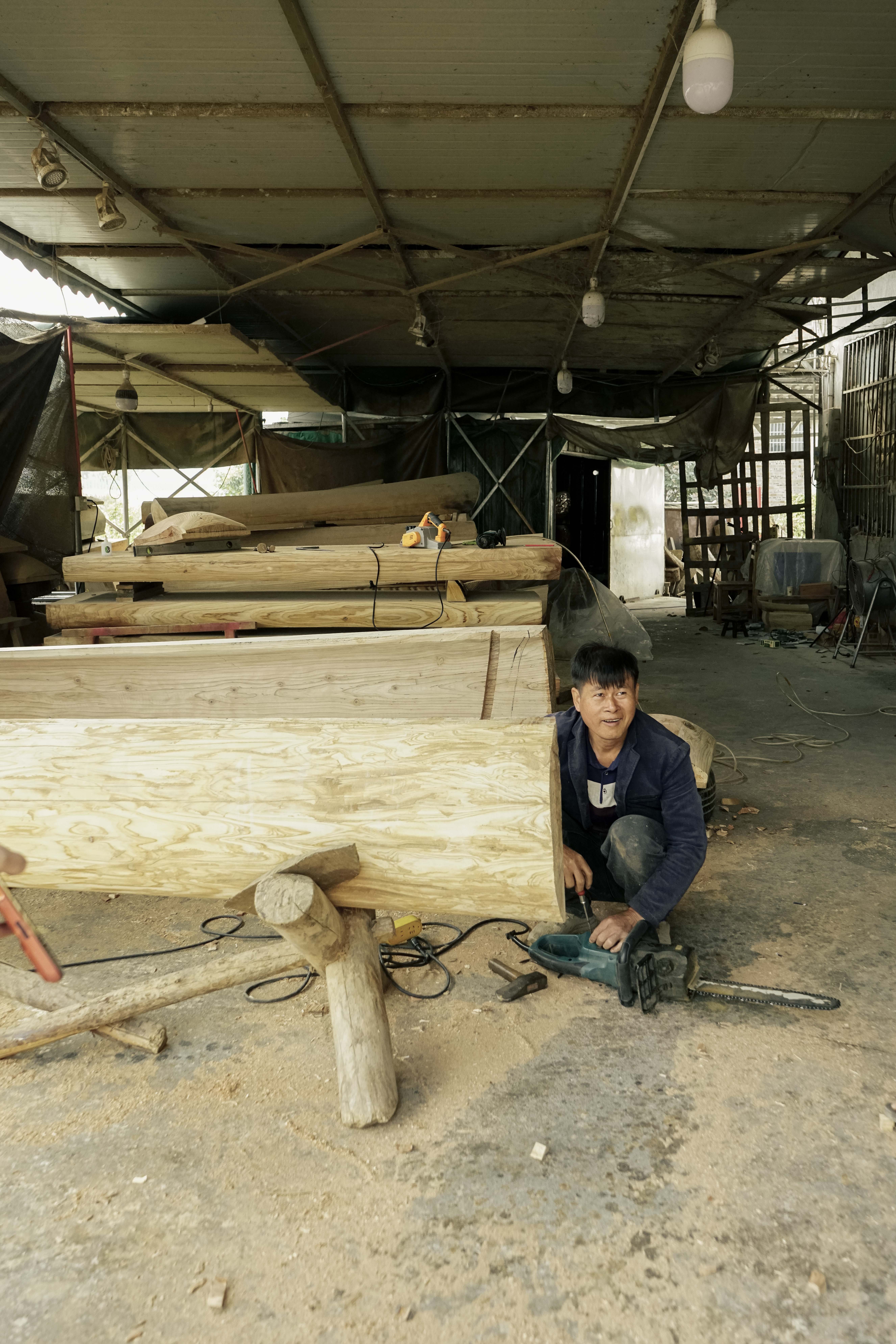
Wu’s Culture Center feels just like a family workshop. In front of a simple village compound, his sister-in-law perches on a little stool, chipping away at rocks lodged in the roots of a giant tree trunk. Nearby, Wu’s brother, the main craftsman, guides a saw through another trunk.
Three trunks and more than a month of digging, sawing, carving, Wu says, go into making a premium final resting place for someone. He blows dust off a prized piece, revealing ornately carved cranes and pines glistening under the glaze.
Coffins are parked everywhere. Raised by a typical Chinese grandmother who swats my mouth at any mention of death, I think of the familiar news stories about urban residents protesting “unlucky” funeral shops. But to Wu, “they’re just furniture”.


Photos: Siyi Chu
From funeral reform to family trade
“My husband often jumps in to show customers the fit,” Wu’s next-door neighbour, Auntie Mo, a Liudao local in her 70s, tells us proudly. “He wants them to see how easy it is to move around inside,” she adds, throwing her elbows around, leaving us wondering exactly who needs the space.
China’s funerary reform, underway since the 1950s, promoted cremation over burial in the name of conserving land for the growing population, and in doing so curtailed demand for coffins. While those in remote areas – “and those with means”, winks Wu – can still bury, the craft and industry may be on its last legs.
In 1979, Wang Ju, a fifth-generation Liuzhou coffin maker, diversified into making mini coffin souvenirs to try and save her family business; others quickly followed suit.
Wu’s family came from another dying business. His father was a traditional one-stop-shop village carpenter in a nearby county. But as rapid urbanisation hollowed out villages nationwide, the brothers pivoted their trade in the 2010s and moved to the nearby Liudao hub.
Some of their neighbours along the same street share similar paths – once furniture makers, they changed lanes in the 2020s, a choice guided by age-old logic: real-estate bubbles may burst, but who doesn’t die one day?


Selling death, one souvenir at a time
Auntie Mo has sold enough to send three children to university. In her garage-sized mom-and-pop shop, she recalls driving out at 3am to collect materials, which her husband then carefully crafted.
Wu claims that a real-estate tycoon in Shenzhen shelled out 600,000 yuan for the most luxurious coffin he’s sold. And a cement boss has bought five coffins from him over the years.
“Perhaps he bought one at age 60 [per tradition], and changed his mind every few years,” he muses. “Some people really chase total satisfaction.”
Unsurprisingly, Wu’s job has given him much opportunity to think about the unpredictability of life. “Many people live aimlessly, working everyday just to make money. But the real goal should be about cultivating patience and an appreciation for what one already has,” says the man who once considered becoming a monk.
“To find happiness we have to look inward. Only through self-cultivation and spiritual practice can we attain happiness, true happiness. I feel that the cycle of birth, ageing, illness and death is ultimately the fundamental meaning of life.”
✦
“How big of a coffin would I need?” I ask. “180cm,” Wu and Auntie Mo say in unison. “When you’re dead, your toes drop forward…and you might want a hat.” Wu explains the extra room in all seriousness. He waits for Auntie Mo to finish chuckling, and adds: “You should make this into a skit and post online. Definitely 100,000-plus views.”
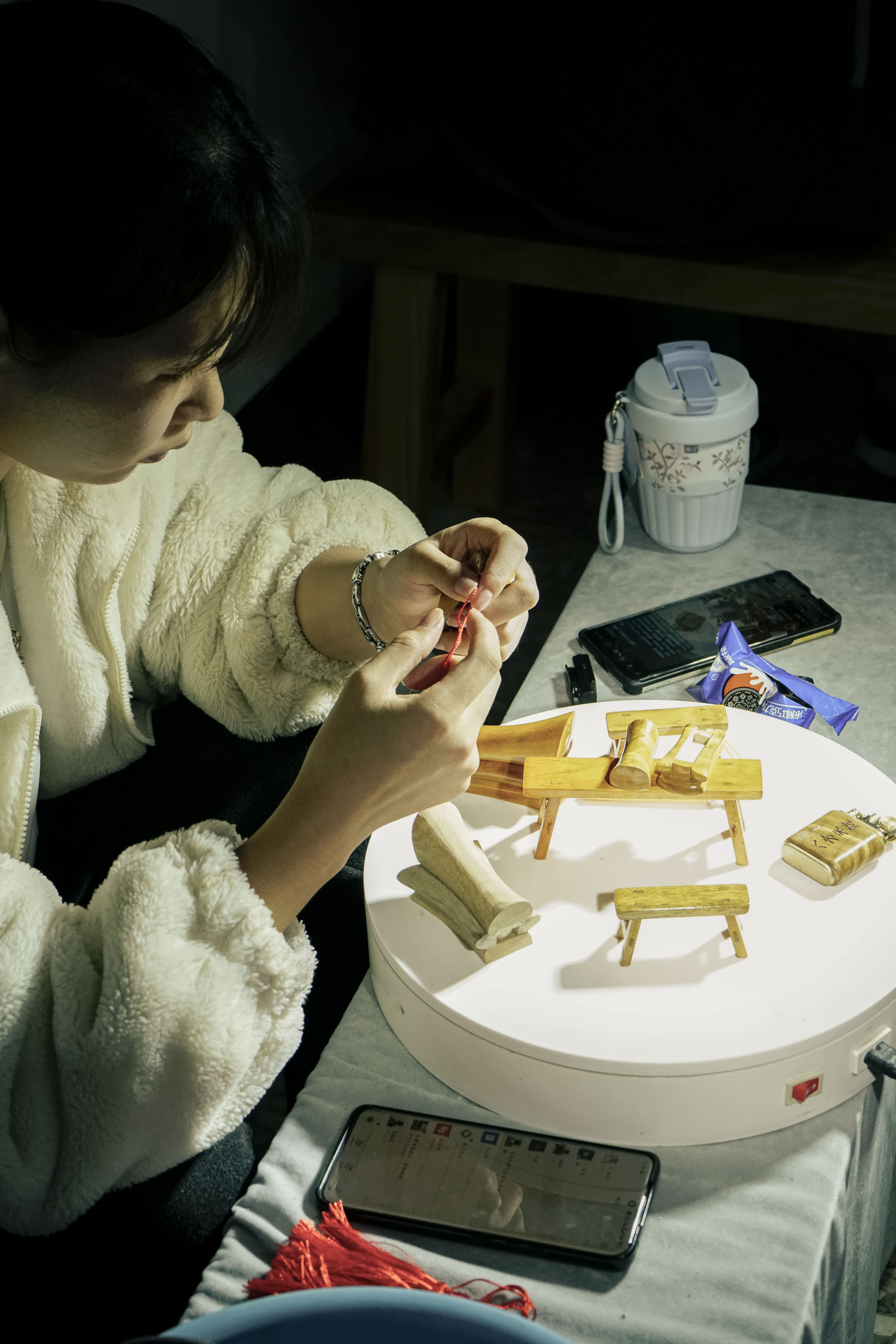
In the office in the back of Wu’s building, two Gen Z employees from Wu’s village are doing a livestream of the mini coffins. Wu pulls out his collection. “See? The Hong Kong style is flatter. Malaysian ones all have red rims…”
His voice grows animated with each item, even though “they don’t bring in much sales”.



Photos: Siyi Chu
Keeping a dying craft alive
For years, Wu has been trying to liven up the trade with a cultural element – partly for competitive edge, he admits, but partly to keep the tradition alive. Stacks of scripts for funny videos on funerary quirks are strewn around the workshop.
“I approached a local official for support, but he was put off by the culture of death,” he says, feeling stuck without resources. Work on the Culture Center’s exhibition area has stalled – there is just one office wall with old coffin-making tools on display, far from his vision of a full-on museum.
The most exciting visit he received, he recalls fondly, was when a Hong Kong NGO found him via social media, and brought young students to learn about the craft and what happens when people die. “So that they will become braver if their loved ones pass away one day…” Wu shares. He still keeps the certificate they presented him on the wall.
In this business, orders sometimes come in a rush, when family elders begin to slip away, and relatives cling to the old belief that buying a coffin might buy them a little more time.
“Call it superstition or whatever,” Wu says, “but when I set my heart on doing it, some elders manage to pull through.”
He has been wading through classic volumes on Buddhism for more understanding on life, but claims “I’m not eloquent enough to explain it, not like the better learned”. He plans to leave his business to fate. Meanwhile, with three children all in stable jobs, Auntie Mo looks forward to closing up shop.
As we say goodbye, Wu offers one last quip: “Life is like taking a bus, you can’t jump straight to the last stop.” Sitting in the car, I watch as he saunters back to preparing for someone else’s final stop.