✦ Hangzhou, home to China's famed Longjing (Dragon Well) green tea, is reinventing its tea culture beyond farmhouse poker games and bus-tour photo stops. ✦ From the centuries-old Jingshan Tea Banquet to a 10-yuan teahouse on Wugong Hill, Hangzhou now offers tea experiences spanning ancient ceremony to contemporary reinvention. ✦ Meijiawu native Xu Mingjun runs a hands-on teahouse where visitors pick, roast and grind their own Longjing leaves, reflecting a shift from sightseeing to participation. ✦ Tea master Mao Wanji and modern venues like cocktail bar One More Tea show how ritual, tea therapy and mixology are expanding what tea means in the city today.
✦
I SPENT MANY weekend afternoons in my pre-teen years staring at flat small green leaves floating in a cylindrical glass.
Since my family moved in the 2000s to Hangzhou, home to China’s prized Longjing green tea, my parents have been doing as the locals do: visiting farmhouses-turned-tearooms a short drive from the city centre to nurse steaming hot cups as they shuffled poker cards across the table. I didn’t care for the taste of the tea – at least, not as much as for the village chicken soup we’d order to cap off the day – or the poker games. So when I got bored, I would run into the fields.
✦
More than a middle-age pastime
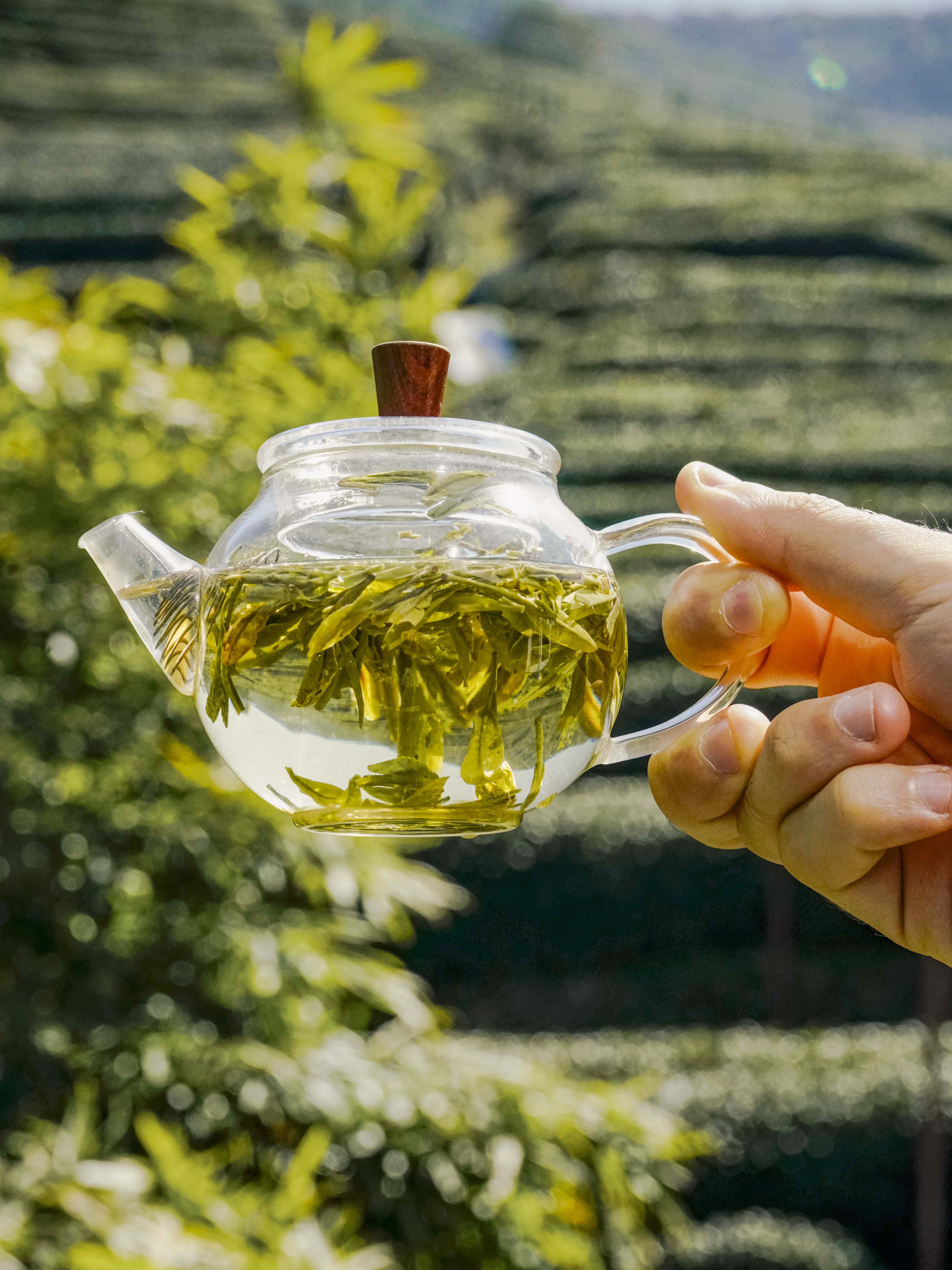
The lines of tea shrubs fill the hillside in broad brushstrokes. After summer rains, their leaves glisten with lingering droplets. Sweet autumnal blooms of osmanthus caress the pavement.
In spring, a soft aroma hugs the surrounding villages as family workshops roast fresh pickings.
Many families were allocated fields in China’s 1984 land reform, and the local government has since invested in innovating tea technology and standardising production, shaping Hangzhou into a tea hub.
When I was a child I never tired of this scene; I still haven’t.


Lead photo: Siyi Chu. Above photos: Davor Tunjic, Siyi Chu
The bus loads of tourists seem to feel the same way. Season after season, they follow a predictable itinerary, raising their phone cameras in the idyllic Longjing or Meijiawu villages with exclamations. Their guides’ megaphones boom with the oft-shared but still-charming tale of a Qing dynasty emperor’s professed partiality for the local brew, which explains its royal name, “Dragon Well”.
Because of these influences, I used to perceive tea’s place in local life as a middle-age pastime or a tourist checkbox.
But within and beyond these fields, the life around tea is just like its shrubs: while their emerald green is a constant, they never cease to sprout something new.
From burnout to tea picking: meet Meijiawu's new generation
In 2019, burnt out from his tech job, Xu Mingjun, a 30-year-old Meijiawu native, came back to start a “tea culture tourism” business, mostly herding small groups around the same old Hangzhou loop of lake-temples-tea fields. But interest wore thin, he recalls. “Visitors would ask: ‘Can we just go pick tea at your family’s farm?’”


Photos: Carefree Little Immortals, Siyi Chu
Now we sit on a terrace at Xu’s teahouse, whose name translates to “Carefree Little Immortal”, located at the end of a narrow village road (much to taxi drivers’ chagrin).
Since humouring those early requests to pick tea, he and his partner Zhu Haiyan have transformed a relative’s old house into a simple space with a menu of hands-on activities: you can don the classic tea picker attire to pick tea, roast fresh leaves by hand or grind them for matcha. By midday, the space was full, and Xu ran off to operate a drone for those who might want an extra aerial angle as a keepsake.
✦
Tea, rather than just sitting pretty in a cup, asks something of its partakers too: that they should use their hands; or talk to a local.
“Tourists used to care more about seeing sights…but now they want to feel the local culture in depth too,” Xu reflects. “I’ve become the same when I travel.”
Ritual and reflection behind every brew
An old local idiom puts tea among the nuts and bolts of life: “firewood, rice, oil, salt, soy sauce, vinegar, tea”. “But there’s also a saying that places tea among the cultivated pleasures: qin (zither), chess, calligraphy, painting, poetry, wine, flower, tea,” Mao Wanji, a certified tea master with more than 20 years of experience in tea education, explains to me in a voice as calm as the morning breeze.


Photos: Carefree Little Immortals, Siyi Chu
Those wanting to dive deeper into the cultures and rituals of tea will find no lack of opportunities here, as young people around China have been signing up to get trained in tea-making. What Mao finds most charming, however, is that no matter how precisely one follows the teachings of craftsmanship, every cup is a reflection of its maker, time and space.
“No two brews are ever the same,” she says as she steadily prepares a pour of oolong in her salon space in a downtown office tower.
“Even the slightest shift in mindset can make you experience different flavours.”
People drawn to this reflective side of tea will find their footing at Jingshan Temple, a two-hour-drive from Longjing or Meijiawu. The monthly Jingshan Tea Banquet revives a Song dynasty ritual that the Japanese monk Eisai introduced to Japan, where it was perfected into matcha and chado.



Photos: Carefree Little Immortals, Siyi Chu
For those who fail to snatch a seat due to the event’s popularity, there are other events, like zen tea reading clubs and salons around the city, not to mention many places, including Xu’s Meijiawu teahouse, where you can try whisking up tea foam and painting on it with tea powder, a process that gained popularity after it was featured in several recent period dramas.
Modern twists on tea
Other venues offer more modern experiences. At One More Tea, Lapsang Souchang meets rum and oatmeal coffee foam in a stemmed glass, with pickled lemon and perilla lifting the smokey creaminess.
Mida, manager and bartender at this downtown cocktail bar with a long tea-themed menu, is not hung up on promoting tea from his surroundings. With a clientele mostly in their 20s, and a habit of building their day around a “morning kick of coffee, two litres of tea for hydration, then tea cocktails at night”, he is instead interested in introducing local customers to teas from around the world through the culture of mixology.


Photos: Mida, One More Tea
Though my parents find his oolong-infused vodka dissonant, they nod enthusiastically when Mao talks them through the new trend of “tea therapy”, which involves folding tea drinking into traditional Chinese medicine. They’re just as intrigued by Xu’s idea to invite visitors even deeper into the production process, perhaps with agricultural work that they recognise from childhood.
I, ironically, pine for the reassuring charm of sipping the day away in one refillable vessel.
Up Wugong Hill in Hangzhou’s old town, for just 10 yuan, you can spend a whole day, cup in hand, listening to the sound of local old-timers slapping cards or mahjong tiles on the table.
If I get bored again, I’ll catch a ride back to Meijiawu, fetch a Longjing Osmanthus Americano from Local Beauty Cafe, the only coffee shop in the village, and soak in the view of the tea fields from every angle possible on the Shili Langdang trails frequented by ancient porters and modern hikers alike.
In this city, there’s a cup of tea for everyone.