In a string of villages along Nujiang Grand Canyon in China’s far northwestern Yunnan, the mood changes as soon as Chinese New Year is over.
✦
Unlike at most places across the country, things shift downtempo quickly as Nu, Tibetan, and Lisu congregations file into small mountain chapels to begin observing the sombre Catholic season of Lent.
In these remote parts – and unusually for a country that is largely non-religious – Catholicism is the main faith, the result of the presence of French missionaries who had failed to enter Tibet in the 19th century and settled in the Nujiang gorges below.
The missionaries introduced European agricultural techniques, documented local tribal languages, and unintentionally helped grow a unique, localised version of the faith that has embedded itself over the years.


All photos: Zachary Tang
✦
Snaking over the rugged Biluo Snow Mountain range, with high alpine passes reaching an elevation of over 4,000 metres, the missionaries’ trail connects Nujiang River Valley on its western end, to Lancang (known as the Mekong outside of China) River Valley on its eastern end.
It’s part of the Ancient Tea Horse Road, the centuries-old network of routes that merchants once used to move tea by horse caravan across the region. Until the Nujiang Grand Canyon Highway was completed in 2019, this was the only route connecting isolated settlements like Qiunatong to the outside world. Today, it is walked by Nu and Tibetan Catholic pilgrims and by trekkers drawn to one of China’s few remaining roadless mountain crossings; a pilgrimage in its own right.


All photos: Zachary Tang
Qiunatong
Qiunatong is the last of the villages reachable by road before Tibet, and the final outpost of the missionary trail on its western end. Zhongding Catholic Church, the more prominent church a short drive away, was closed for renovation on the Sunday I visited; a priest there redirected me to Qiunatong, where Mass was proceeding as usual.
The church itself is built in Tibetan style, its walls and ceiling adorned with biblical imagery alongside Tibetan script. The congregation, mostly of Nu descent, followed the liturgy from missals (printed prayer booklets) while chanting in Tibetan, the cadence closer to Buddhist scripture than anything I thought would be associated with a European Mass.


All photos: Zachary Tang
Wuli
From Qiunatong the trail continues to Wuli, a village name that translates to “shrouded in mist”. Reaching it means crossing a large wooden bridge onto a cliffside stretch of the old Tea Horse Road, the path worn into the rock face over centuries, its overhang forming a natural shelter along the route.
Wuli remains inaccessible by vehicle today, but perhaps not for long – construction material for a new road was arriving by drone the day I passed through, flown in across the river gorge and unhooked by workers at the village edge.



All photos: Zachary Tang
Bingzhongluo and Zhongding Church
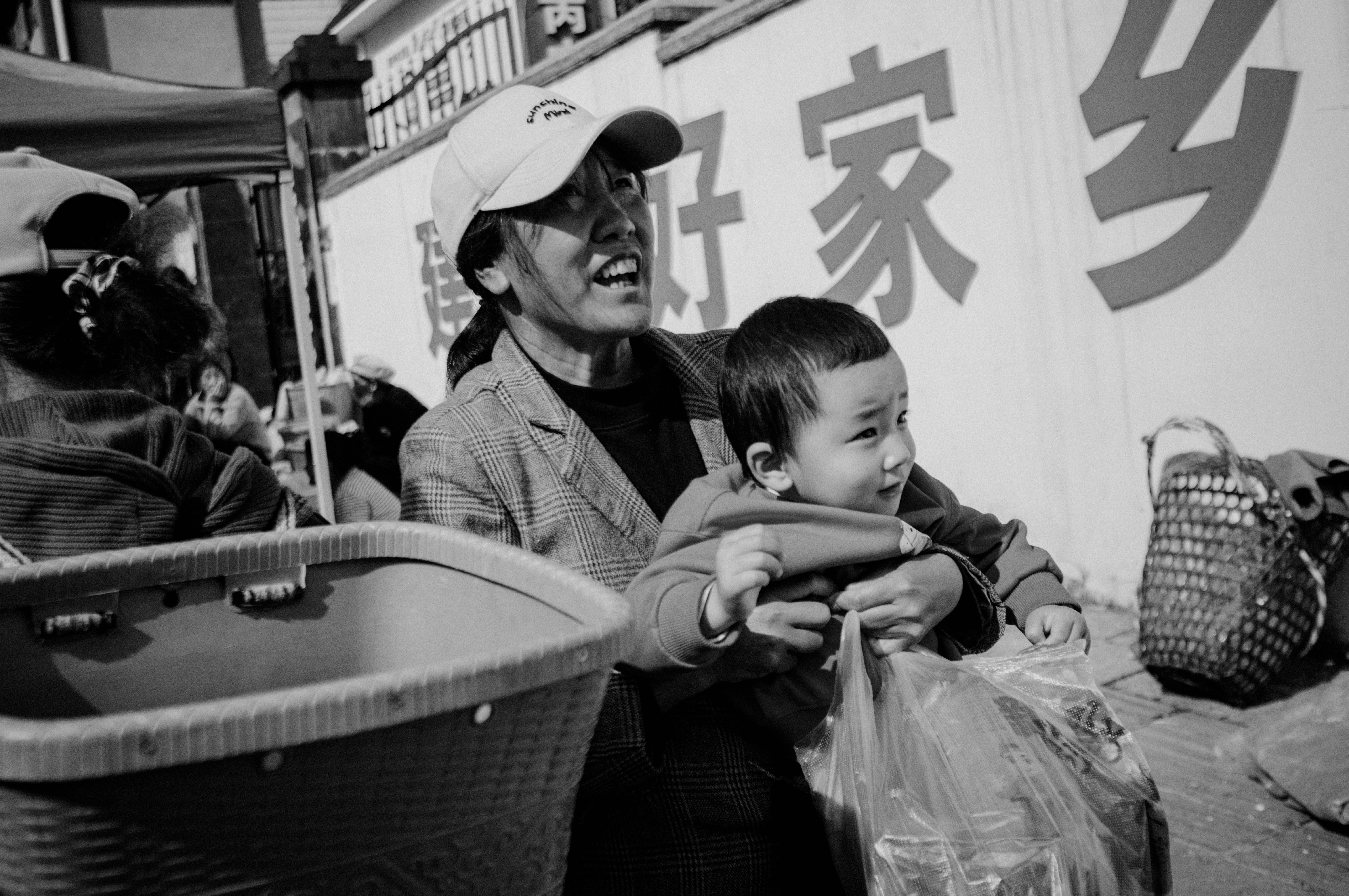
Bingzhongluo, a larger town downriver, hosts a weekly street market that draws people down from the surrounding hills to stock up on supplies, many shouldering the region’s traditional back-basket, once woven from bamboo and now more often made of plastic. Livestock changes hands here: chickens by the crate, pigs waiting in the backs of pickup trucks.
A few kilometres up the road from the market stands the Zhongding Catholic Church, built in 1908 by the French missionary Father Annet Genestier (and which was closed for renovations on the day I visited). Its bell tower has marked time over the valley for more than a century, through a period in which European liturgy gradually blended into the surrounding culture.


All photos: Zachary Tang
Gongshan
An hour and a half south of Bingzhongluo is Gongshan, the county seat and the largest town in the area. After the villages, the density of its concrete buildings can come across as a shock against the backdrop of the mountains. But the Nujiang River runs past it much as it has for millennia, indifferent to the town’s fortunes.
In Gongshan I obtained permission from Father Ruo Wang, who is of Lisu descent, to photograph a Tuesday evening Mass. A theology student in Paris, he had walked the old missionary trail more times than he could count.
Later, he drove me to my hotel and we talked through the night about how the state intervenes in church affairs, how different faiths coexist in the valley, and why he thought the mountains themselves inspired religious feeling.
Baihanluo
Baihanluo, the oldest church on the trail, sits at its western mouth and would likely have been the first sign of settlement for missionaries descending from the high passes near Cizhong. First constructed in 1898, it has burned down and been rebuilt more than once. Reaching it means climbing back north through an hour of mountain passes, often shrouded in low cloud.
It’s also the least European-looking church along the route. In place of stone arches are lattice windows and upturned tiled eaves in the style of a temple roof, with a small iron cross set into ceramic tiles above the entrance. Folk panels painted with baoxiang flowers (stylised peonies and lotus blossoms rendered in mineral blues and greens) flank the doorway. Master craftsmen from Dali directed the construction, while local villagers supplied the labour, producing a Catholic sanctuary built in the local architectural language of the valley.


✦
As strange as it was to discover Catholicism so high in the mountains of China, the feeling wore off quickly. Spend a while here and it all starts to feel natural: the Catholic liturgies chanted hypnotically in Tibetan, the temple–shaped chapel roofs, the church courtyard as village meeting ground – all part of the story of a community that has long since claimed a faith from far away as their own.