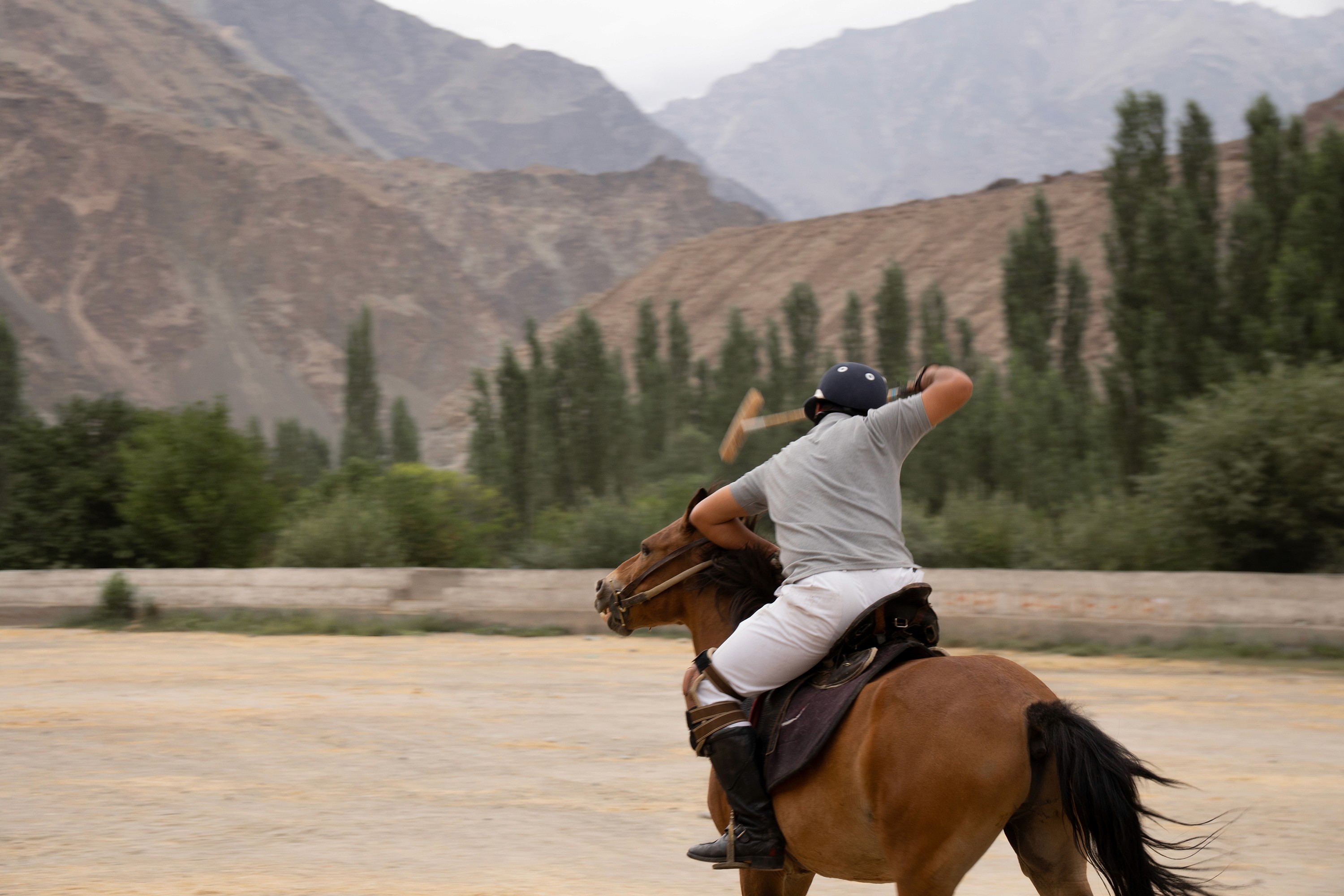
✦ Turtuk, one India’s most northernmost villages on the Ladakh-Pakistan border, is home to a rougher, music-driven version of polo, a game locals believe originated in the Baltistan region. ✦ After decades of decline following the end of royal patronage, the sport is being revived through local hotels, clubs and families. ✦ Boutique hotel owner Rashidullah Khan founded the Virsa polo team in 2024 and is opening a community stable to widen access, since not every family can afford a horse. ✦ Tournaments now run beyond the traditional Nawroz (spring equinox) season into July and August, with free matches open to a growing number of tourists visiting this once-closed border village.
✦
RASHIDULLAH KHAN POURS a deep purple brew into cups, passing them around a low table in a lush apricot orchard. As we sip the mulberry and basil tea, he shares snippets from his life: studying at the local school without regular teachers; not owning a pair of proper shoes in childhood; feeling overwhelmed when he travelled to the big city of Bangalore for college; and returning home to open a boutique hotel, Virsa Baltistan, in this remote corner of India. His smile rarely fades, even when recalling the challenges of growing up in Turtuk, a region isolated from the rest of India for decades.
Amid the hardship, there was also joy. Rashidullah remembers learning to ride horses and play polo as a young teenager on Turtuk’s shagarans, or polo grounds.
The sport runs in his family: his father, Abdul Rashid Khan, was a famed player, known for his rough style and spirited steed; spectators used to shut their eyes nervously when he played.
Rashidullah founded the Virsa polo team after opening his hotel in 2024 – part of a broader effort to preserve and promote Balti culture, of which polo plays a significant part.


Lead photo: Marie-Ève Aubertin. Photos: Virsa Baltistan (left, middle); Reem Khokhar (right)
Turtuk, the “last village” of northern India, sits a few kilometres from the India-Pakistan border in the high-altitude desert of Ladakh, at roughly 9,800 feet above sea level. Formerly part of Pakistan, it’s one of four Balti villages in the Baltistan region – now divided between Pakistan-administered Gilgit-Baltistan and Indian-administered Ladakh – that came under Indian control after the 1971 war. This sensitive border area was closed to outsiders until 2010.
Since then, tourism has begun helping residents reclaim and share their Balti identity through food, crafts, music – and now, increasingly, polo.
A wilder game
Polo’s origins are unclear. Versions of the sport are believed to have been played by Central Asian nomadic tribes, refined in ancient Persia, and then spread across the continent.
Baltis, however, believe polo originated in Baltistan. 'Polo' means round in the Balti language, a reference to circular objects, and oral tradition traces the game to children playing with the round roots of wild roses, giving rise to “Sia Polo”, or rose polo. It was played first on foot, then increasingly on horseback.


Photos: Gaby Conn, Reem Khokhar, Marie-Ève Aubertin
This isn’t polo as it’s commonly known, but a free-spirited Balti game that’s rougher and set to music. On rugged ground flanked by stark mountains, six players per side charge on horseback at full speed, driving a ball with their mallets toward goalposts.
Winners traditionally receive an offering of meat from the losing side, sometimes even a cow, sheep or goat. Trophies were more recently introduced, but the traditional “goat parties” continue.
✦
The sturdy mountain horses trained for the sport are prized for their endurance and cultural standing. “Stories tell of people selling their houses and land just to buy a horse,” Rashidullah says. “And legend has it that when a horse prays for its rider, it wishes that he falls like a feather.”
Beyond ploughing fields, the animals aren’t used for labour, and Baltis traditionally don’t name them – a mark of respect. “Their spirit is larger than labels,” Rashidullah explains.


Photos: Marie-Ève Aubertin, Reem Khokhar (middle, right)
Tournaments run for a week or two, with daily matches between eight teams drawn from the four Balti villages. Games are played in two 45-to-60-minute halves; the first side to 10 goals wins.
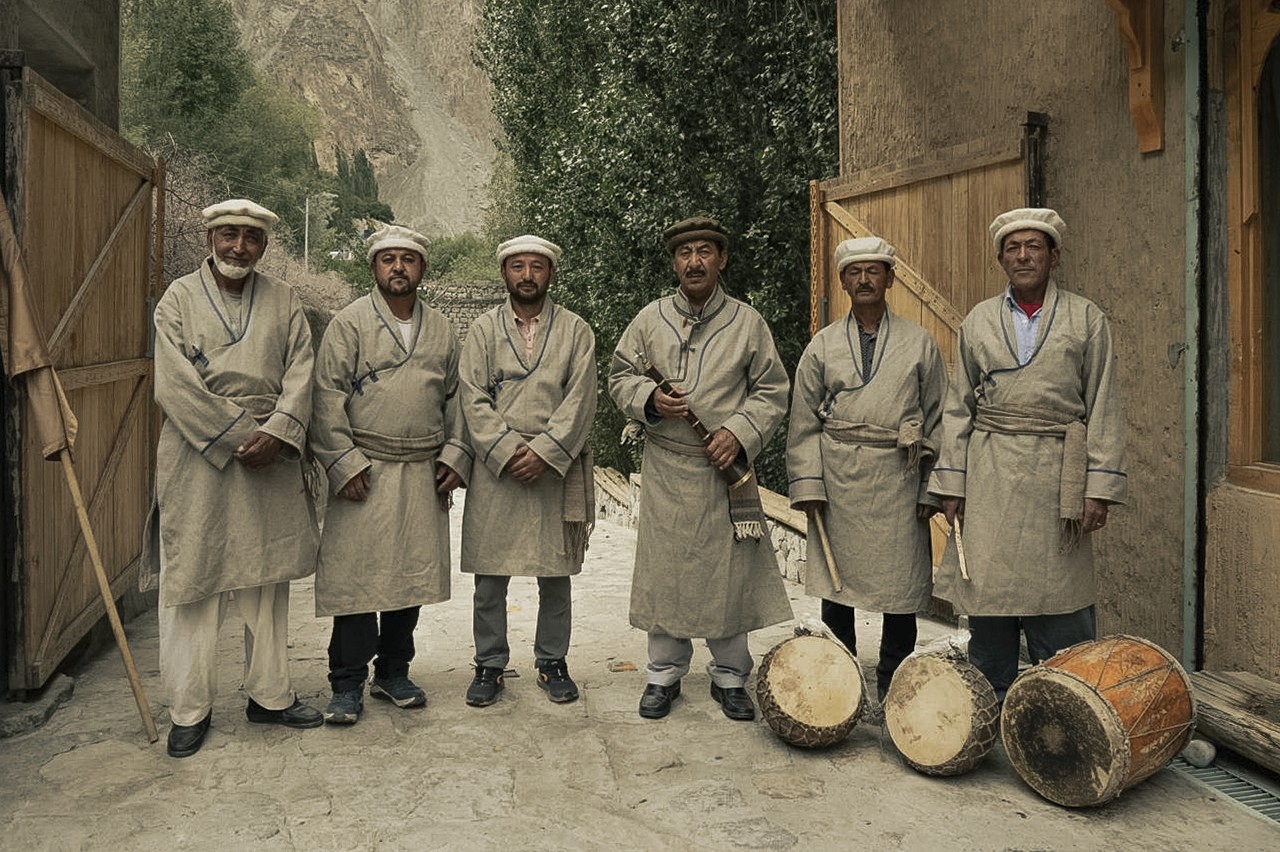
Music runs through every match: drums, the gyaling and the surna, both traditional wind instruments, cue both players and horses, with different tunes marking a leader’s arrival, the start of a gallop, or a goal.
“Music sets the rhythm of the game and awakens the spirit of the horse,” Rashidullah says. “In Turtuk, we call this moment ‘urba’ – the burst of enthusiasm before polo begins.”
Rooted in the region
Polo once flourished across Ladakh under royal patronage, and the remains of shagarans still dot Ladakhi villages. Play declined as royal rule ended, though in recent years, local organisations and clubs have driven a revival across the region.



Photos: Pachuk Nyoma
In Turtuk, the effort has been gradual, but is increasingly visible. Over the past decade, the number of teams has doubled, from around four to eight.
“Our version of polo should not die out, as it is the essence of this region,” says Abdul Rahim Bangchu, a shepherd, landowner and retired player. “Maintaining the authenticity of the game is important.”
Because of the region’s harsh winters, polo in Turtuk is seasonal, and was once restricted largely to Nawroz, the Persian new year marked on the spring equinox around March 21. It is now played through the warmer months, with a second tournament held in July and August, when the grass is, as the locals say, “fully bloomed”.
Widening access
Shahnawaz Yagbo, the prince of Turtuk’s former royal family, doesn’t play polo himself but wants to see the sport thrive again. He often hosts players’ post-match gatherings at his ancestral palace, now a visitor museum.
“Polo needs to be more accessible,” he says. “Some families cannot afford horses and therefore cannot participate.”
Expanding that access is one of Rashidullah’s priorities. Virsa’s retired polo horse is already used by local boys learning the sport, and by the end of this year he plans to open a stable of four to six horses for community members to train with.


Photos: Marie-Ève Aubertin
For younger players, the revival points beyond cultural preservation, toward representing Baltistan in Ladakhi tournaments and, eventually, on the national stage.
“I am excited for the potential of the game to extend beyond Turtuk and the local tournaments,” says 19-year-old Nassir Hussain, the face of the Virsa polo team.
Tourists are gradually being folded into that vision. Matches are free and open to visitors, and this year’s Nawroz games drew a handful of international spectators.
There are plans to bring polo into visitor itineraries more formally, while hotels like Virsa already offer introductory sessions where guests can learn to hold a mallet and hit the ball from horseback.
These efforts sit within a broader push to keep travellers in Turtuk longer. Often treated as a day trip from Nubra Valley, the village rewards a lengthier stay: museums, orchard and mountain hikes, Balti cuisine, homestays, and cultural experiences from artisan workshops to music and dance.
For a community long on the margins, tourism offers a chance to celebrate and share a distinct cultural identity – one in which polo plays no small part.
“Polo in Baltistan is more than a game,” Rashidullah says. “It is an emotion, a shared trust between human and animal that has existed for centuries. For us, it is heritage, folklore, and identity.”


